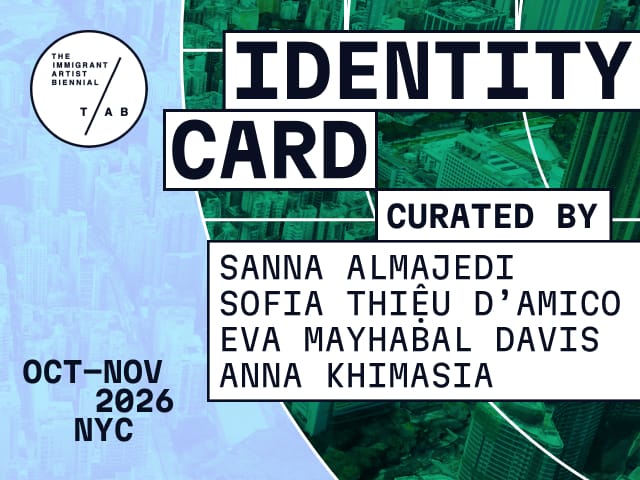
Anna Khimasia on curating The Immigrant Artist Biennial
Anna Khimasia is a co-founder of International Arrivals. She discusses artists whose practices engage urgent political and cultural questions.


Anna Khimasia is a co-founder of International Arrivals. She discusses artists whose practices engage urgent political and cultural questions.

What are some of the unique opportunities and challenges in curating time-based art?
My first curatorial project was a survey of video performance works by Black British artist Harold Offeh, and it profoundly shaped the way I think about art and exhibitions more broadly. I am consistently drawn to artists who use the body as a site of inquiry, whether through time-based media, performance, installation, or even painting. I think that I am particularly interested in time-based work because it invites audiences to inhabit time and space differently.
I have also curated several performance events and have taught courses on performance art at UCLA and Carleton University in Canada but I think that performance art, as a category, continues to still be challenging for audiences; perhaps because it often occupies a space of uncertainty, vulnerability, or discomfort. Yet it is precisely this openness and unpredictability that makes performance so compelling.
What are you working on next?
I am excited about a curatorial project I have coming up next year, but it hasn't yet been officially announced. What I can share is that it is called The Deluge and the Crossing, and it is an exhibition bringing together contemporary international artists whose work explores water as both a harbinger of instability and a catalyst for transformation. Against the backdrop of climate crisis, ecological collapse, and geopolitical upheaval, the exhibition considers water as a force that floods, divides, carries, and reshapes our relationships to land, to one another, and to the future.
I will also continue my work as the co-founder of International Arrivals (IA) and the IA podcast will continue featuring artists whose practices engage urgent political and cultural questions. Next up is a conversation with Nicholas Galanin, who is of Tlingit and Unangax̂ descent and whose work speaks to Indigenous sovereignty and the violence of colonialism.
The poem “Identity Card” by Mahmoud Darwish inspired the title for this edition of The Immigrant Artist Biennial. What is another poem that nurtures you in your work?
Originally a spoken-word performance and later published in book form, Kae Tempest’s Let Them Eat Chaos is a text that I carry with me. It follows seven strangers who find themselves awake at 4:18 a.m. each wrestling with their own fears, loneliness, and sense of disconnection. Through these intertwined lives, Tempest creates a portrait of a fractured society marked by inequality, anxiety, and political disillusionment.
Let Them Eat Chaos is also very much about class, which is something I think we don’t talk about enough in the United States. Discussions in the States are often very focused, and rightly so, on race and gender, but I believe that class is another important lens through which to understand this country and the people who live in it. I return to this poem because it reminds me that our individual struggles are often collective struggles, shaped by the systems that bind us. It also reinforces, for me, that we can’t really talk about race, gender, or class without recognizing the intersections and interconnectedness.