Museum of the Moving Image announces technology lab and artist residency
MoMI LAB is a free, artist-led co-creation space in New York where the public can engage directly with the emerging technologies shaping everyday life.


MoMI LAB is a free, artist-led co-creation space in New York where the public can engage directly with the emerging technologies shaping everyday life.
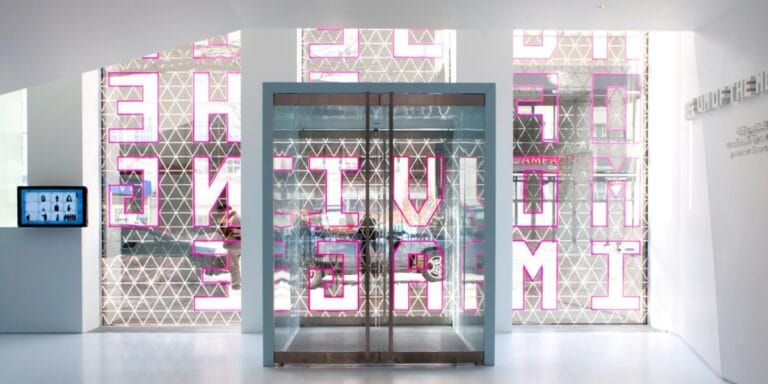
Both a co-creation studio and an artist-led space, MoMI LAB provides free access to the technologies shaping everyday life while fostering understanding about their impact—the space opens June 13.
Located in the Museum’s lower level, MoMI LAB is a free, artist-led co-creation space where the public can engage directly with emerging technologies—not only to use them, but to understand, question, and shape how they are transforming everyday life. Concurrent with the LAB’s opening, the Museum will launch its first-ever artist residency program. We look forward to welcoming the public to discover, create, and reflect in this space where people from varied backgrounds can interact with new technologies and each other, helping to bridge the digital divide.
The brand-new 2,400 sq. ft. space was designed by Ralph Appelbaum Associates and Lopergolo & Bartling Architects. It encompasses a public education area featuring interactive stations and a “tinker” space, two dedicated studios for artists-in-residence, and a classroom space for demonstrations, workshops, and presentations. The LAB offers access to emerging tools including immersive media, spatial technologies, AI, robotics, and digital production systems. Inaugural programming will include artist residencies, workshops, public events, and open sessions designed to foster practical literacy, creative exploration, and shared understanding.
“MoMI LAB is meant to level the playing field by providing free, accessible tools to not only learn technology, but reflect on it, and create with it,” says Gabo Arora, MoMI’s Director of Strategic Initiatives who led the vision and strategy for the LAB, and organized recent events about AI, immersive storytelling, and more. “We are at a moment where there is accelerating change. MoMI LAB democratizes these tools and allows people to understand what these technologies are doing to us and our society. By placing artists at the center, the LAB foregrounds experimentation, interpretation, and critical inquiry as essential to understanding technological change.”
Leading into the June 13 opening of MoMI LAB, the Museum will present a preview of Escape the Internet, a live interactive game developed by Lucas Rizzotto, to be played in the Redstone Theater on May 28.
Aziz Isham, MoMI Executive Director, reflects that “the emerging media lab is unlike anywhere else in the world because it is a place where we are shaping the future with the participation of the public. These technologies belong to everyone; they should be accessible to everyone. If you’re not getting them at home and you’re not getting them at school… There is a place where you can get exposed to these technologies here at the Museum in Queens.”
Educational programming and operations for MoMI LAB will be led by Ramsey Sweatmom, Associate Director of Art and Technology Programs. MoMI’s uniquely accessible education programs are tailored to engage visitors of all ages and experience levels. With free access during regular Museum hours, visitors to the LAB will encounter drop-in interactive experiences as well as deep-learning stations—facilitated by Museum educators—and events including masterclasses, hackathons, product demos, panels, presentations, and lively conversations to increase the public’s understanding of the technology that shapes their lives today, and provide the critical thinking tools for the understanding of its future.
Visitors to MoMI LAB can:
• Learn about the phenomenon of stereoscopic vision at the Lenticular printing station; and make your own 3D postcard to take home.
• See through the eyes of a robot canine.
• Discover NeRFs and splats, two ways of turning real-world images into a navigable 3D scene.
• Explore how computers render procedurally generated environments in virtual reality.
• Find out how Artificial Intelligence uses machine learning to turn prompts into text, images, and video.
• See how machines turn data in a digital file into a real-world dimensional model at the 3D Printing Station.
• Play with sensors and servos to see how robots navigate physical space.
• See how the practice of projection mapping can transform any shape surface.
As an evolving modular space, MoMI LAB programming will adapt to emerging technologies and ideas. As with all of the Museum’s educational programming, MoMI LAB seeks to transform passive consumers of media into active creators and critical thinkers.
Artist Residency Program
MoMI LAB will launch its new artist residency program with inaugural Artist-in-Residence Rachel Rossin, selected by Arora and Regina Harsanyi, Associate Curator of Media Arts, and made possible by funding from Agog: The Immersive Media Institute. Rossin identifies time, which is the essence of the moving image, as a key focus of her practice spanning painting, virtual reality, and immersive installation. Her work at the residency focuses on spatial computing, examining the slippage between virtual and physical space to build hybrid sites for escape and reflection. In her own words, Rossin explains: "I'm thinking about perception, embodiment, and how spatial computing can create experiences that engage people on neurological, conceptual, and emotional levels. There's so much potential there to move beyond spectacle and create work that's genuinely rigorous and meaningful." This framing aligns directly with MoMI LAB’s goals: not technology as novelty, but as a tool for deeper engagement and public understanding.
Four additional artists-in-residence will be presented over the next two years with support in part from the Rockefeller Brothers Fund’s Culpeper Arts & Culture program.
Artists are invited to embark on critical explorations of emerging technologies ranging from quantum computing and machine learning to biocomputing, wearables, and beyond. They will engage the community through workshops and public events, co-creating with them and showing their work in progress. Each artist is given a stipend and designated studio space connected to MoMI LAB. Throughout the residency period, visitors are encouraged to drop in for behind-the-scenes glimpses into the creative processes taking place in the resident studios. Together with MoMI's Education and Curatorial teams, artists-in-residence also help shape the lab's offerings and share their knowledge through public discussions, demonstrations, and workshops.
The residency culminates in a public program or showcase that spotlights the artists’ groundbreaking projects and offers insight into the transformative potential of the rapidly advancing fields explored through the program. Artists-in-residence also collaborate on shaping the Museum’s hardware and software inventory, including VR/spatial equipment, EEG devices, and creative tools.
“There’s a fallacy out there that technology leads the way, then artists experiment with that technology,” explains Aziz Isham. “But if you go to our labs and exhibits, you will see that as the moving image evolved, it was actually artists who led the charge. It was artists who were trying new tools, who were experimenting with new forms of storytelling. Artists have always been a crucial part of the development of technology, and that is still true today.”
For more information visit the MoMI site.