Sharmistha Ray emerges with animated realities
Sharmistha Ray speaks about extending the spatial logic of paintings into time with their three-channel animation Emergent Realities.


Sharmistha Ray speaks about extending the spatial logic of paintings into time with their three-channel animation Emergent Realities.
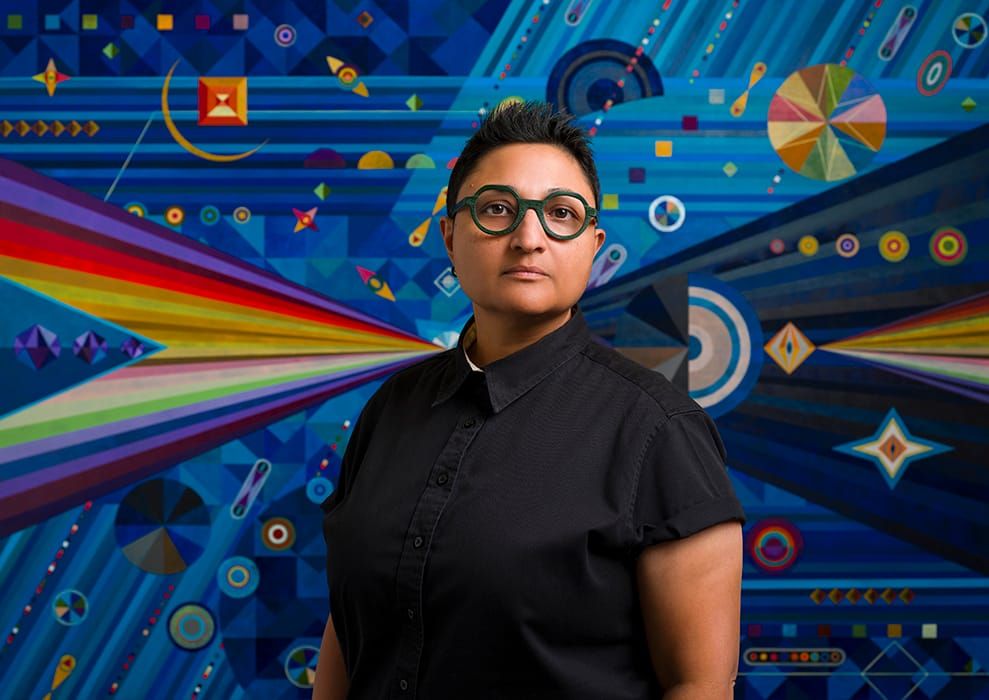
Sharmistha Ray is a visual artist whose work delves into the complex inheritance of multiple cultures through their queer identity. Working primarily in painting and drawing, they have also made work in sculpture, installation, electronic media – and now animation. Pittsburgh Cultural Trust recently commissioned Ray to make a three-channel animated piece for their Wood Street Galleries. The resulting work, Emergent Realities, collages painting, original and found footage, and cosmic imagery into a layered visual odyssey. The piece also features a newly-commissioned sound composition by Grammy Award-winning musician and vocalist Arooj Aftab.
We spoke to Ray about their numerous public art projects, which include a mosaic at Grand Central Station in New York, and also their entrance into the field of moving image art. As Ray states, what draws them to a moving image is its capacity to hold multiple temporalities at once. Read more about how Ray aims to deepen this relationship through collaboration and experimentation.
You have recently completed a number of public art projects, among them a mosaic at Grand Central Station in New York as well as a piece installed at Pittsburgh International Airport. What are some of the unique challenges of making work for public spaces, and how do your methods shift as a result?
Working in public space requires a fundamental shift in how I think about audience, scale, and durability. Unlike the more intimate encounter of a gallery, public artworks must meet viewers where they are; people who may not be seeking art, but encounter it in the peripheries of daily life. That means the work needs to operate on multiple registers: it should be immediately legible at a distance, while also inviting sustained looking.
There are also material, budgetary, and logistical constraints. Working with mosaics, for instance, involved a translation from a digital design into a medium that must withstand time, touch, and environmental stress. This requires collaboration with fabricators, engineers, and architects, which I see as an expansion of my practice rather than a limitation. Conceptually, I think more about collectivity and shared experience, how abstraction can create a sense of belonging or resonance across difference. The work becomes less about a singular viewer and more about a public ecology of perception. That said, you don’t want to dilute the work conceptually or aesthetically to appeal to everyone. You have to know that’s impossible. It’s a fine balance between maintaining artistic integrity and speaking to people on a fundamental level through a shared experience.
On a more granular level, every medium has its own unique qualities. Mosaics, for example, have materiality, shape, size, color, texture, and distinct capacities for reflection and absorption. They can be glossy or matte, polished, rough, or metallic; they can express directionality through their placement. My collaborator and I were faced with a multitude of options for what was already a very complex piece in terms of design and color. Once you get past the sheer number of choices, you begin to respond to the material, and that’s when the play, and the magic, happens.
For the Pittsburgh International Airport, the medium was also glass, but industrially-produced. In some ways, it offered a different kind of ease, because you’re not working with thousands of individually-cut pieces, each with its own irregularities. The precision of the material allows for a certain clarity in execution, but it also introduces a different challenge, how to retain a sense of intimacy and tactility within something that is scaled-up and industrially-fabricated.
For me, that intimacy emerged through color and through dynamic compositional elements such as layering, movement, and rhythm within the design that invite the eye to travel and linger. Even within a highly controlled material, there are ways to create a sense of vibration and responsiveness, so the work doesn’t feel static or impersonal.
Public projects are also deeply site-specific, and the artist has to be attentive to context, history, and the communities the work is addressing. In the case of the airport, I was thinking about the space as a threshold, an in-between zone where people are arriving, departing, waiting, transitioning. It’s a space that holds a broad cross-section of people across geographies, cultures, and social strata, often all at once.
The work engages with themes of nature, technology, and community, but not in a literal or didactic way. Instead, it offers a set of interrelated ideas. Visual forms that evoke flow, connectivity, and interdependence. Airports are highly technologized environments, yet they are also deeply human spaces shaped by emotion, anticipation, and movement. I was interested in holding those tensions together.
In that sense, abstraction becomes a particularly generative language. It doesn’t prescribe a single meaning, but instead creates an open field where different viewers can find their own points of entry. In a public context like an airport, that openness is crucial. It allows the work to remain inclusive while still maintaining its conceptual and aesthetic integrity.
My next public project, Geometry of Play – which opens to the public this July – is a set of painted murals for three pickleball courts in downtown Pittsburgh. It’s part of Arts Landing, which is managed by the Pittsburgh Cultural Trust, and just opened to the public this April. I’ve been told that they’re the first artist-designed pickleball courts!
Many of your works feature exuberant plays with vivid colors. How would you describe your aesthetic, and what were the primary influences on the development of your style?
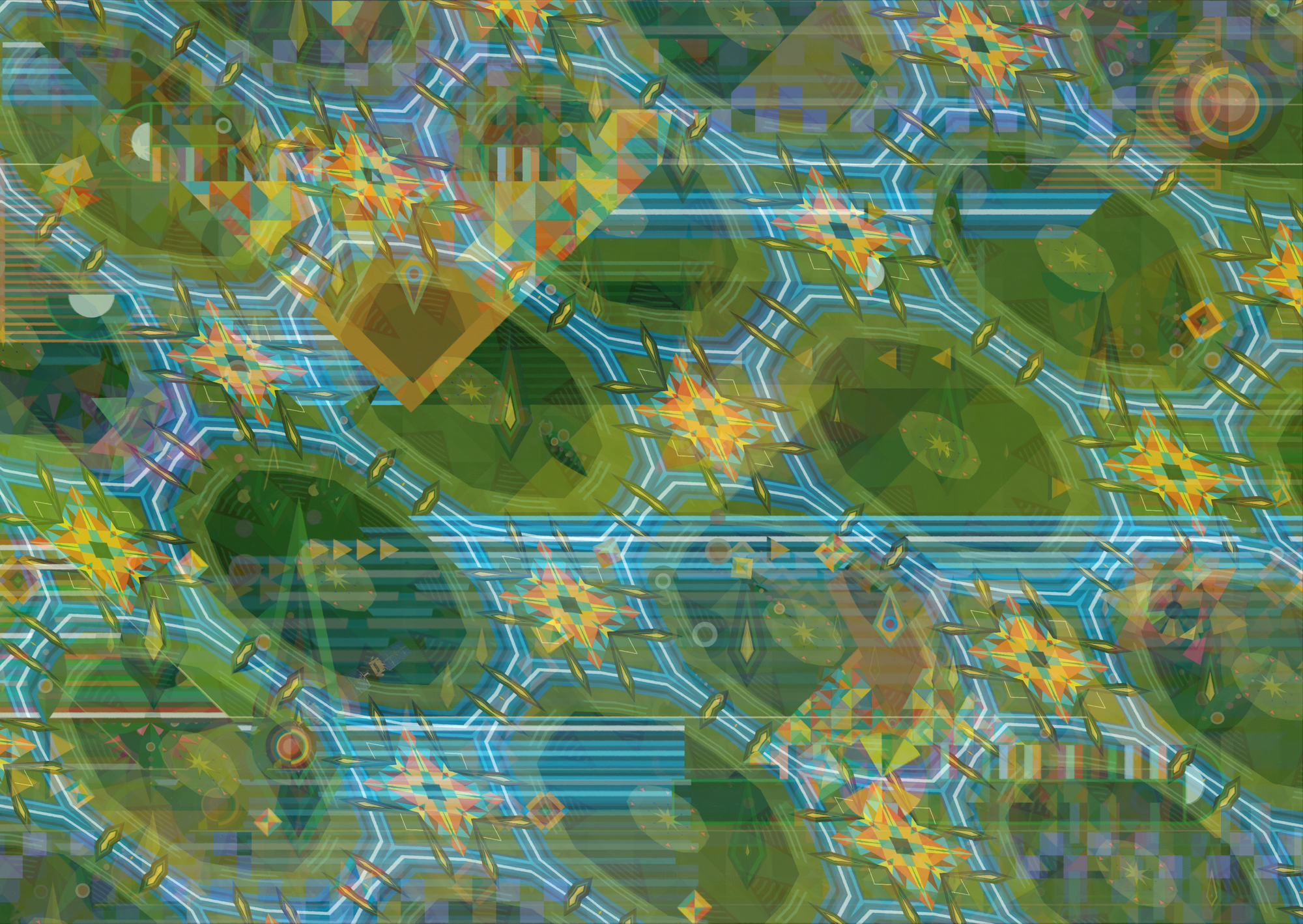
My aesthetic emerges from a deep engagement with color as both a formal and affective language. The palette draws from South Asian visual cultures – including Hindu, Jain, Buddhist, and Islamic cosmologies, textiles, miniature painting, and ritual practices such as idol worship – but it is also shaped by global histories of abstraction, particularly the pedagogical and material investigations of the Bauhaus.
I went to India after I finished graduate school because I wanted to explore color. Prior to that, my work was largely monochromatic. I didn’t really “trust” color. It seems like such an odd thing to say now. Color has a plurality to it; it is always relative to everything around it. To understand color, you have to surrender to it completely. You can never quite control it; you can only be in concert with it, and then you move together.
That understanding is deeply connected to the body. The experience of color, for me, is somatic. It moves through sensation, perception, and affect. Kundalini meditation brings me into relation with color as energy, something that resides within the body and moves through it. Through the chakra system, color is understood as vibrational and embodied, and while I don’t map these systems directly, they inform how I think about color as alive, shifting, and charged with energy. I see my color worlds as direct expressions of this experience of somatic consciousness.
Equally important is my engagement with pattern-making, particularly through the lens of Indian textiles. I’m especially influenced by Kantha from Bengal, where I am from, which is a tradition of stitching together layers of cloth through repetitive, rhythmic running stitches. Kantha is both intimate and expansive: it emerges from domestic labor and care, yet produces complex fields of pattern, texture, and narrative. The surface is built slowly, through accumulation, where small gestures gather into larger compositions.
This logic of pattern, of repetition, variation, and improvisation, deeply informs my work. Like Kantha, my compositions often unfold as fields rather than fixed hierarchies, where elements echo, mutate, and circulate across the surface. There is a sense of time embedded in this process, a durational unfolding that resists immediacy. Pattern becomes a way of holding multiplicity, of allowing different forms, colors, and energies to coexist without collapsing into a single focal point.
I’m interested in how color and pattern together can hold contradictions, how they can be sensuous and disorienting, ecstatic and destabilizing at once. In this way, my work is also shaped by queer and feminist approaches to abstraction that resist rigid hierarchies of meaning. Color becomes a way of thinking through multiplicity, of holding together different temporalities, geographies, and identities without resolving them into a singular narrative space. It’s less about harmony and more about a charged coexistence, where multiple narratives, through color, pattern, and compositional language, can reside simultaneously.
Your new work Emergent Realities, commissioned by Pittsburgh Cultural Trust, is a three-channel animation. What inspired you to work in animation, and what challenges and opportunities did the format present to you?
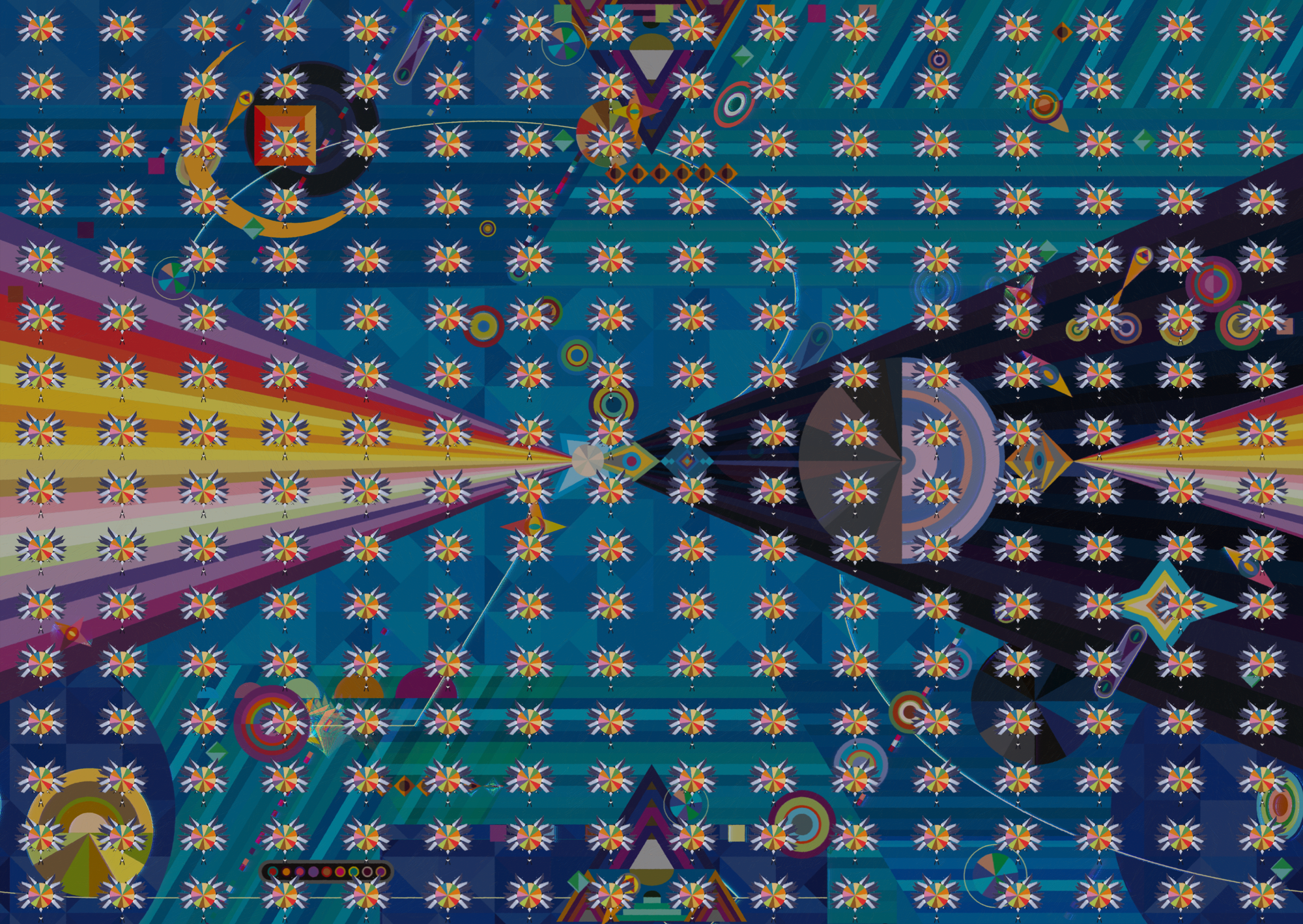
Animation allowed me to extend the spatial logic of my paintings into time. I’ve long been interested in non-linear temporality, in how different scales of existence, from the cosmic to the intimate, might coexist, and moving images offered a way to activate that. The excitement and the challenge come from the same source: seeing an image I’ve created begin to move, to acquire duration, rhythm, and transformation. It suddenly has another set of characteristics, but then the question becomes, what next? How do you structure time through abstraction? How do you retain visual, emotional, sensory interest over a period of time?
Those questions (and others) led me to think more deeply about sequencing, but also about deep time, temporalities that exceed human perception. I began incorporating cosmic imagery, including NASA-sourced visuals, alongside interplanetary images, as a way to stretch the abstract image beyond the frame of the human and into a larger cosmological field. These elements don’t function illustratively; rather, they expand the conditions of abstraction, allowing it to operate across planetary and interstellar scales.
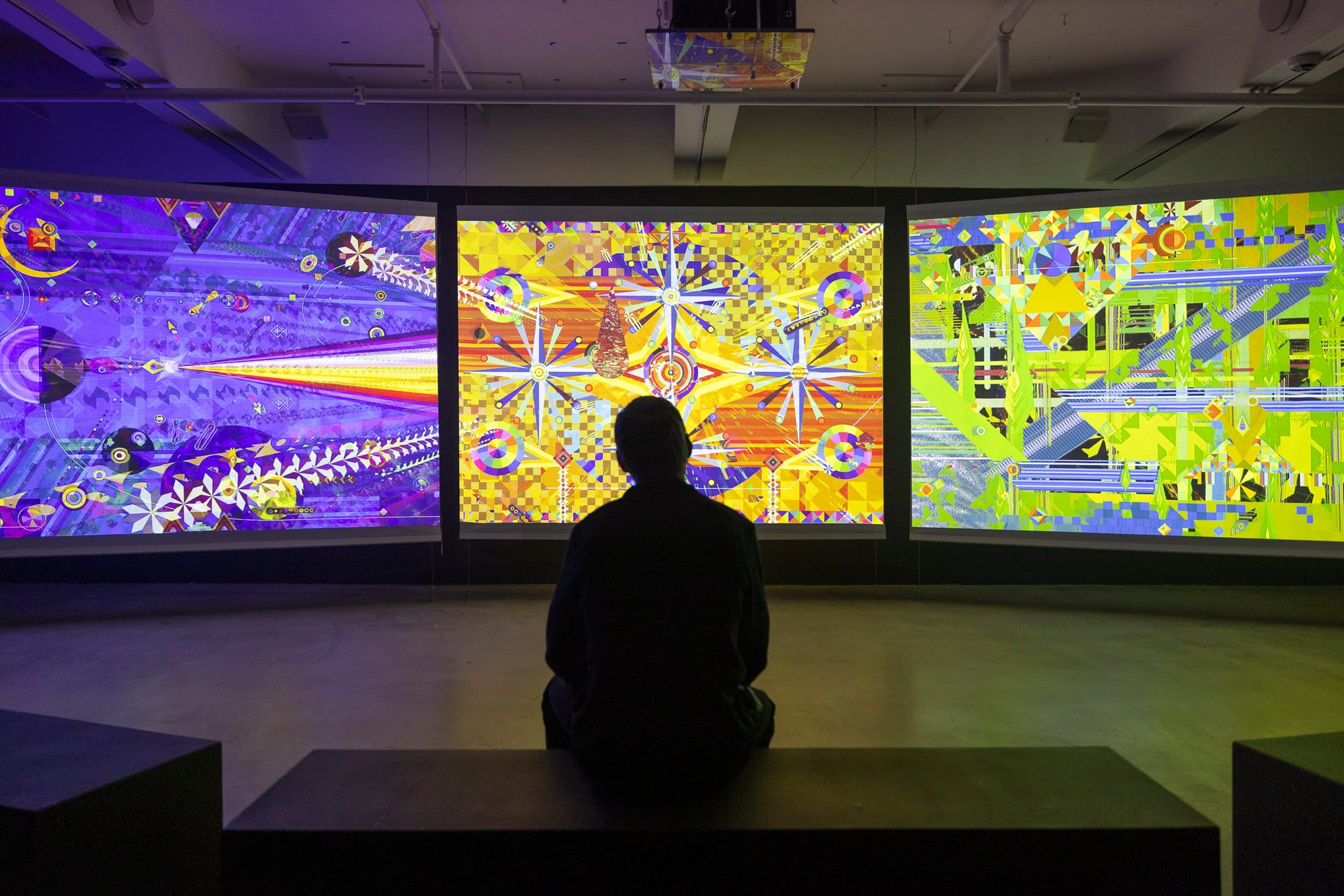
The three-channel format became essential to this exploration. It creates an expanded field in which multiple temporalities can unfold simultaneously rather than sequentially. Each channel operates as its own temporal register, sometimes echoing, sometimes diverging, sometimes colliding with the others. Together, they produce a sense of inter-temporality, where past, present, and future are not ordered but entangled. Cause and effect no longer appear as a linear chain, but as a coexistent field of relations.
In Emergent Realities, this manifests through layered juxtapositions: satellites drifting across one channel while painterly forms dissolve into stellar dust in another; comets arcing through space alongside textures that evoke ecological transformation or collapse. The work moves across ecological, cosmic, and psychological scales, suggesting that these are not discrete domains but deeply interconnected ones. What happens in one register reverberates across others.
Spanning terrestrial, solar, and cosmic realms, the three channels function almost like parallel dimensions of time and perception. They invite the viewer into a space where time loops, splinters, and converges, where memory, matter, and speculation coexist. This is closely tied to my ongoing interest in cosmology and consciousness: the idea that our bodies are composed of the same atomic matter as the cosmos, and that we exist within an intricate web of relations that extends far beyond the visible.
Animation also introduced very practical challenges. It required me to think through duration, pacing, and rhythm in ways that static work does not, as well as to navigate new technical processes and collaborative workflows with my Technical Director, Alexander Nathan Soto, who is a brilliant animator. But those challenges opened up new possibilities. The work could breathe, shift, and transform over time, creating a more immersive and perceptually-complex experience.
Ultimately, the three-channel structure allowed me to address more expansive, entangled dimensions, where abstraction becomes a way of sensing our embeddedness within multiple, overlapping realities across space and time.
Emergent Realities features a score by Grammy Award-winning musician Arooj Aftab. How did that collaboration come into being, and what characterized the creative process between the two of you?
My collaboration with Arooj Aftab emerged from a shared interest in poetics, atmosphere, duration, and the emotional resonance of sound and image. I had long been moved by her ability to stretch time through music. Her compositions often feel suspended, as though they exist outside of linear progression. Her voice has that transcendent quality.
Her practice draws from a rich range of influences: South Asian classical traditions, Sufi and Urdu poetry, jazz, folk, and pop. That ability to move across genres while remaining deeply rooted in cultural memory resonates strongly with my own approach to abstraction, where forms emerge from specific histories but remain porous, able to connect outward across different visual and conceptual languages. There is also something powerful in how she makes the timeless feel contemporary without losing its depth and signature, which is something I strive for in my work as well.
I had been aware of Arooj’s work through South Asian artistic communities in Brooklyn before I moved to Pittsburgh to teach at Carnegie Mellon. But it was her Grammy-winning vocal performance in Mohabbat that really stayed with me. There is an emotional clarity and restraint in her voice that feels incredibly expansive. When I began working on Emergent Realities, I knew the project needed a sound dimension that could hold that same sense of temporal elasticity, and she was my first choice. I was fortunate that she agreed.
However, I wanted a composition from Arooj, rather than a vocal piece; for me the voice is similar to a human figure in a work of art: it becomes the subject. I wanted something instrumental, and more experimental. My own musical preferences tend towards sound, electronic, atmospheric, abstract. The process itself was intuitive and dialogic rather than prescriptive. I shared a nearly complete version of the animation, about eighty percent resolved and she responded with a composition that already had a strong internal logic. When I gave feedback, it was minimal; I didn’t want to overdetermine the direction. There were certain elements, like the piano register, that felt especially resonant, so I encouraged her to lean further into those tonalities. The second iteration she sent felt complete.
What became interesting was how the two works began to shape each other. I incorporated aspects of her sound into the animation so that, at moments, it feels as though the images are being activated or carried by the score. She titled the composition Kinship, which feels like an apt description of the collaboration itself. It’s not about perfect synchronization or resolution, but about relation, how two distinct forms can meet, diverge, and still remain connected.
Her score doesn’t simply accompany the animation; it expands it. There’s a shared willingness to allow for space, drift, and ambiguity. At times, sound and image move in parallel; at others, they splinter and occupy their own trajectories. The result is a dynamic interplay of harmony and dissonance, where convergence and separation are equally important.
Together, the work creates what I think of as a temporal ecology, where each moment feels like origin, consequence, and reflection at once, unfolding within a larger, continuous field of relation across space and time.
You are a founding member of the feminist collective Hilma’s Ghost. Tell us about the type of activities the collective is involved with and what your upcoming plans are.
Hilma’s Ghost is a collaborative project that brings together feminist, queer, and spiritual approaches to art-making and research. From the beginning, it has been as much about a way of working as it is about what we produce, rooted in dialogue, shared inquiry, and an openness to experimentation that resists singular authorship. Our projects often take shape through exhibitions, workshops, performances, and publications, and we frequently draw on esoteric traditions such as tarot, not only as a symbolic language, but as a methodological tool for thinking, making, and collaborating.
Working collectively allows us to inhabit a different rhythm of practice, one that is iterative and relational. Rather than arriving at fixed meanings, we are interested in processes that remain open, where abstraction, spirituality, and feminism intersect as modes of inquiry and world-building. Tarot, for instance, becomes a structure through which we explore narrative, archetype, and chance, while also reimagining systems of knowledge that have historically been marginalized.
This ethos extends into our recent and upcoming projects, which have been unfolding across a number of institutional and public contexts. Our permanent public work Abstract Futures at Grand Central Terminal brings together abstraction, magic, and feminist symbolism through a large-scale glass mosaic, drawing on archetypal imagery from our tarot deck to reframe the everyday experience of movement and transit. In a different register, our solo exhibition Light as Resistance at Museum of Contemporary Art Tucson presents painting, drawing, video, and site-specific wall work that functions as a kind of ritual proposition, engaging abstraction as a tool for protection, healing, and collective transformation.
We are also part of A Queer Arcana: Art, Magic, and Spirit at the Palm Springs Art Museum, curated by David Evan Frantz, which situates our work within a broader lineage of artists engaging esoteric knowledge as a means of queer world-making. Upcoming projects include a tarot drawing in a summer exhibition at the The Morgan Library & Museum in New York, a group exhibition curated by Amy Hale at University of North Carolina at Charlotte, and a group show at Sheldon Museum of Art focused on witchcraft, opening in January 2027.
So there is a lot unfolding, but what connects all of these projects is a shared commitment to thinking collectively about how abstraction, spirituality, and feminist practice can open up new ways of imagining relation, knowledge, and transformation.
Individually, I have a solo project opening at Moody Center for the Arts at Rice University in Houston this October. I can’t divulge much about it at this time, but I can share that it may involve extraterrestrial phenomena!
Do you see yourself making more moving image work in the future, and if so what type of work in this area might interest you next?
I do see moving images as an expanding part of my practice, and I’m thinking about it in increasingly multidimensional ways. I’m interested in what happens when you push beyond even the three-channel format, by using multiple screens to explore different frequencies of space-time, to think through multiverses, parallel temporalities, and entangled phenomena that unfold simultaneously rather than sequentially. It’s about extending both spatial and temporal experience even further, so the viewer is immersed in a field rather than positioned in front of a single work.
What draws me most to a moving image is its capacity to hold multiple temporalities at once, and to create environments that unfold durationally. I’m particularly interested in multi-channel installations and hybrid forms that combine animation with live-action, sound, and sculptural elements. Works that operate across registers and resist fixed boundaries between mediums.
Sound will continue to be central to that exploration. I’m curious about working with more complex sonic structures, perhaps multiple scores that overlap, diverge, or even contradict one another, creating another layer of temporal and spatial dissonance. I’m open to experimentation, especially in how sound and image can co-construct experience rather than simply align.
Going forward, I also want to deepen the relationship between moving image and ritual, thinking about how duration, repetition, and sensory immersion can produce transformative experiences. Collaboration will be an important part of this, working across disciplines to build layered, immersive worlds that extend beyond the frame and invite viewers into a more expansive, participatory encounter with time and perception.